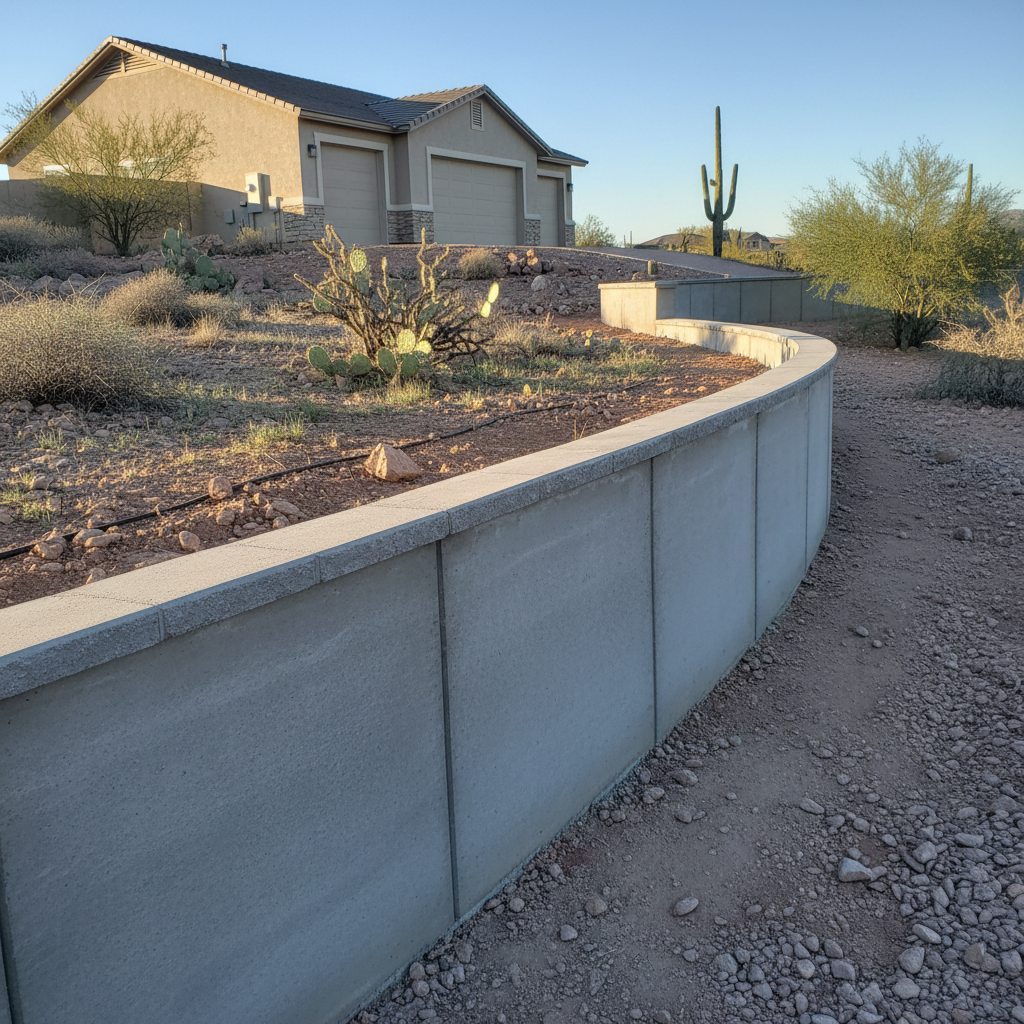
Most people pick a concrete contractor the same way they pick a pizza place, by price and how fast someone answers the phone. That works out fine for a pizza. A driveway you're going to park two cars on for the next twenty years is a different bet. Concrete work in Casas Adobes has its own failure points, and a contractor who hasn't worked this ground before will find out the hard way, usually after you've already paid the deposit.
What's under your yard matters more than the bid
Most lots in this part of Pima County sit on a layer of caliche, that hard, almost cemented calcium carbonate crust that forms a few inches to a couple feet down. It's nearly impermeable, which means water sitting on top of it doesn't drain, it just pools or runs sideways until it finds a low spot in your yard. A contractor who hasn't dealt with caliche might treat it like regular soil and skip breaking it up properly, which leaves voids under the slab that show up later as cracking or settling.
A good crew will rip or break through the caliche where it's shallow, then bring in compacted aggregate base, usually 4 to 6 inches of it, and compact it in lifts, not just dump it and run a plate over the top once. Ask how they're handling base prep on your specific lot before you ask them for a price. If they haven't walked the site, the price they quote you over the phone isn't worth much.
Ask what's actually going into the mix
"Concrete" isn't one product. The psi, the thickness, the reinforcement, and the joint spacing all change depending on what the slab is for.
- A standard walkway or patio runs about 4 inches thick with 3000 psi mix. A driveway or anything vehicles sit on should be 5 to 6 inches with 3500 to 4000 psi, because our heat cycles stress the surface more than people expect.
- Rebar (typically #3 or #4 bar on a grid) holds a slab together better than wire mesh, which tends to sag to the bottom of the pour if nobody chairs it up properly during placement. For driveways and footings, ask for rebar specifically.
- Control joints should be cut within the first 24 hours after the pour, spaced roughly 8 to 10 feet apart, or about 24 to 30 times the slab thickness in inches. Skip this and the slab will crack on its own schedule instead of yours, usually right through the middle of your new patio.
Any contractor who can't answer these specifics without checking a chart on their phone hasn't poured enough concrete to be trusted with yours.
Permits and setbacks around here
Most of Casas Adobes is unincorporated Pima County, so permitting for driveways, footings, and most slab work runs through Pima County Development Services rather than a city office. Depending on the job, that can mean a setback check against your property line, especially for anything near the front of the lot or close to an easement. A straightforward patio replacement often doesn't need the same scrutiny as a new driveway apron tying into a county right-of-way.
If you're in one of the newer subdivisions off Oracle Road or Ina, there's a decent chance an HOA has its own review process on top of the county's, covering things like finish color or where a slab can sit relative to the property line. Older neighborhoods built in the 60s through 80s generally don't have that layer, but they often have older sewer or water lines closer to the surface that a contractor needs to locate before digging footings.
A contractor who tells you permits aren't necessary for your project might be right, or might be hoping you won't ask. Either way, get it in writing which of you is pulling the permit and who's responsible if an inspection fails.
Working around the weather here
Monsoon season, roughly July through September, is the one stretch where timing a pour badly can cost you the whole job. A downpour on fresh concrete can wash out the surface finish or erode the base underneath before the slab has set. Contractors who work here regularly watch the forecast closely during those months and will push a pour date rather than gamble on an afternoon storm.
Summer heat creates its own problem even on a clear day. When it's 105 to 110 degrees, concrete can lose surface moisture faster than it can cure, which leads to a weak, dusty top layer or shrinkage cracking. That's why a cure in July should get a curing compound or wet burlap, not just a quick spray and a wave goodbye. Expect light foot traffic to be fine after about 24 to 48 hours, vehicles after roughly 7 days, and the slab won't hit full strength until around 28 days, no matter how hot it got in the meantime.
What to walk away from
A few things that should make you end the conversation:
- No license or insurance they're willing to show you. Arizona requires a contractor's license for this kind of work, and asking to see it isn't rude.
- A quote with no mention of thickness, psi, or reinforcement, just a square footage price. That number hides a lot of decisions you'd rather make yourself.
- Pressure to pay the full amount before the pour, or a start date that's suspiciously immediate with no site visit beforehand.
- Vague answers about how they're handling caliche removal, drainage slope, or where expansion joints meet your house foundation.
On the other side, a contractor worth hiring will walk your lot, talk about the soil and the slope before talking price, and give you a written timeline that accounts for cure days, not just the day they show up with the truck.
If you want a second opinion on a quote or you're not sure what questions to ask next, take a look at our concrete contractor work around Casas Adobes and the surrounding area. A short site visit tells you more than any phone estimate ever will.